
America@250: Clint Smith & Tim Miller on Grappling with the U.S. and Its Contradictions


Tim Miller interviews Clint Smith on The Bulwark podcast.
Tim Miller: How are you processing where we’re at today and the backsliding we’ve done recently? There are probably going to be some Americans out there not contemplating deep historical weight of what’s happening and gleefully enjoying fireworks and hot dogs. My guess is if you’re listening to this podcast right now, you’re not one of those people. So, I’m wondering how you’re thinking about July 4th and what you’d say to people who are struggling with where we’re at on this anniversary.

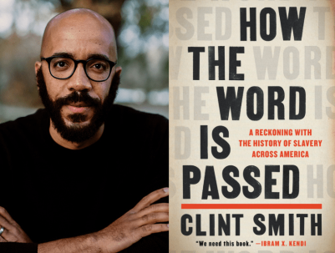
Clint Smith: I was on tour with the Young Readers edition of How the Word Is Passed when it came out last year. I was talking to a bunch of middle schoolers.
As I was sitting with them in their classrooms, I said, “I’m somebody who has done things in my life that I’m proud of and I’m somebody who’s done things in my life that I’m not proud of because I’m human and I make mistakes.”
What I try to teach my children and how I try to be in community with people is not pretend as if you never made a mistake or did anything wrong. What you try to do is you acknowledge your mistake. You recognize the thing you did wrong, and you try to learn from it and address it so that you can become a better version of yourself in the future. And if that’s the standard I hold myself to, if that’s the standard I hold my children to, if that’s the standard these middle schoolers hold themselves to, then why would we not hold our country to the very same standard, right?
We recognize that America is a lot of different things to a lot of different people. In order to understand what the last 250 years have been, I think you have to accept that these 250 years have looked very different for lots of different people. and that we are celebrating in many ways one iteration of America’s birthday.
But some would say that America should have a different birthday and it should be 1965, right? Because that is when Black people and a wider range of citizens were able to more fully participate in the democratic process.
If the goal of America is to be this singular multi-racial, multiethnic, multi-faith democracy in a way that has never existed in the history of the world at this scale certainly, then our job is to acknowledge what it takes to get there.
I think the aspiration of America is a noble one, a remarkable one. Again, like there is there is nowhere else on earth that has tried to do what we are doing, that has tried to, with many millions of people of many millions of different backgrounds, build a country and sustain peace in a country in a democratic way.

Tim: Can I be a downer? Can I just be the downer? I used to be the Republican, and I used to be the flag waver. It was my favorite holiday. As a kid. And now it’s become melancholy. I wish it wasn’t.
Clint: From the moment enslaved people arrived on these shores they were fighting for freedom. They were fighting for emancipation. They were fighting for liberation. What that also means is that the vast majority of people who fought for freedom never got a chance to experience it for themselves. But they fought for it anyway because they knew that someday someone would.
And I think all the time about how my life and my children’s lives are only possible because of generations of people who fought for something they knew they might never see, but who fought for it anyway because they knew that someday someone would.
I think about my responsibility. I think about what responsibilities does that bestow upon me? does that bestow upon my kids to try to build the sort of world and build the sort of country that we might not see ourselves, but to try to build it anyway, to try to be part of the project of making it what it set out to be, even if we don’t get to reap the benefits of it.
It’s like we’re all chipping away at this wall, and you don’t know if the wall is 6 inches thick or 6,000 miles thick. But what you know is that the more you chip away at it, the less the people who come after you will have to chip away at.
I think that’s part of what sustains me in moments like this where things feel hard and when things feel as if they’re not moving in the way that we want them to, in moments where it feels as if progress is fleeting.
I remember that I am part of a history, part of a tradition of people who gave their lives and who fought over the course of their lives to build a sort of country that they knew they wouldn’t see. And to build it for people they knew they would never meet but to do it anyway. And so that’s what I think about when Juneteenth comes around. That’s my Fourth of July.
I also think about it again a few weeks later when July 4th comes around. I think it’s appropriate that they are in proximity to one another. Because I think Juneteenth is a reminder of what the Fourth of July can be or should be. It’s just work, man. We just got to put in the work.
Tim: You’re stirring a little something in me. I’m not ready to wave my mini American flag yet. I’m getting there.
I’m curious about the kids book, Remembering Slavery and How it Shaped America, the kids version of How the Word is Passed.

Tim: You’re talking about conversations with the middle schoolers and it makes me wonder. A lot of people probably having these kinds of conversations with kids this July 4th weekend.
In your book, How the Word is Passed, you’re going to old plantations and speaking to descendants and to Confederate reenactors and trying to grapple with this legacy a couple hundred years later. How is that different when you’re talking to younger people? How do you frame it in a way that gets a good reaction out of them that you feel is valuable?
Clint: I think that for kids, the both-andness of America, the duality of America is one that feels easy to digest. It’s the grown-ups that come and mess everything up, right? Kids are like, “Yeah, America’s done good stuff and America’s done bad stuff.”
Tim: Do you sand the edges down?
Clint: I think you talk about things in a way that’s developmentally appropriate. I think about this with my kids all the time. I got a nine-year-old and a seven-year-old. I don’t want it to be the case that my children are never introduced to difficult topics until they are 16 years old. I think that would be failure.
But when I talk to them, they are children who are the descendants of enslaved people. They are the descendants of Nigerians. They are the descendants of pilgrims. And so, they carry within them a lot of the dynamic stories of what makes America what it is.
So, [with my children] it’s important for us to talk about the history of colonialism that created the civil war that led their grandmother to come from Nigeria to America. It’s important for us to talk about the fact that my grandfather – their great-grandfather who we just visited in New Orleans last week – that his grandfather was enslaved. And what implications that has for the world they live in and to remind them how recent these parts of history are.
I can talk about it with my 9-year-old in a way that I have to be more mindful of with my seven-year-old because each kid is different, each age is different. I wouldn’t say it’s sanding the edges necessarily, but I think it’s knowing who your kid is, knowing who your audience is, and trying to get a sense of what way you can introduce the subject matter to them without overwhelming them.
Tim: It’s tough, man. I got an 8-year-old. It’s interesting that you talk about the ways your kids have all this different stuff within them because it’s been a challenge for me. I was a white kid growing up in Denver in the white suburbs and I learned about Rosa Parks, I learned about Martin Luther King, and it feels like something that is from another world. It felt to me growing up like something that had no impact on me at all or my family and it wasn’t until I was older that I realized, ‘oh wait that happened in the 60s, like my parents were alive.’
And counter that to growing up in and now living in New Orleans with my daughter, who is Black, growing in New Orleans with all the history everywhere around us, and being at a school where you’re starting to learn that stuff and you’re like ‘oh wait those were my people that had to suffer through that.’ I’m going through it the first time with her and trying to figure out how to be constructive and be positive while also being honest.
Clint: We as parents have to be mindful of both the opportunities that we have and the constraints we have in the way we talk about these things. So, I am the descendant of enslaved people and can speak to that history in a way that is deeply personal in a way that I cannot speak to what it means to be an immigrant from Nigeria, right? But my wife can speak to my kids about her mother’s experience and what it means to be a child who has to walk from Nigeria to Cameroon on her brother’s back as a young girl to escape a war that killed millions of people, what it means to not know when you’re going to get your next meal.
I think for any parent, part of figuring this out is knowing to what extent we are bestowing information on our kids or whether we’re on this learning journey together. A lot of things with my kids, I say, ‘I don’t know, let’s figure it out.’ I think there is power in parents having the humility to say, I’m still learning about this, too.
◊ ◊ ◊

◊ ◊ ◊

From the moment enslaved people arrived on these shores they were fighting for freedom. They were fighting for emancipation. They were fighting for liberation. What that also means is that the vast majority of people who fought for freedom never got a chance to experience it for themselves. But they fought for it anyway because they knew that someday someone would. Clint Smith


