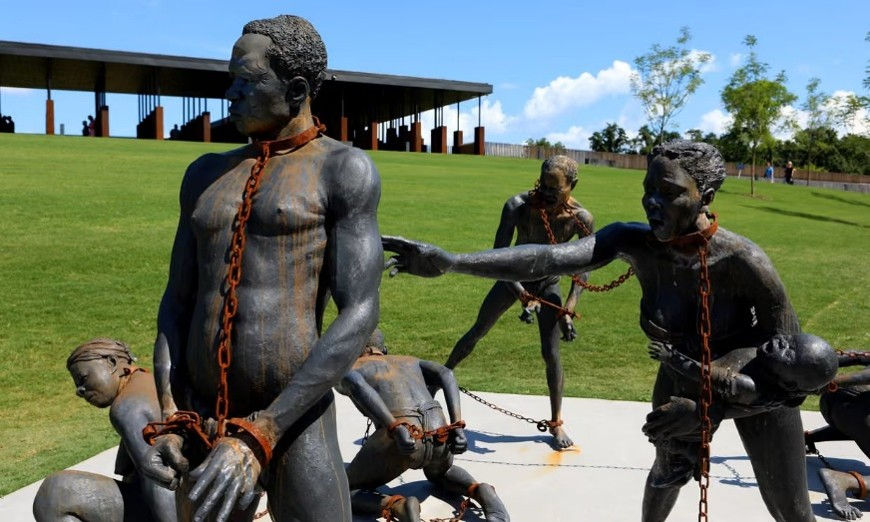
America@250: South Africa and Germany Inspire Narrative History Design at Montgomery’s Legacy Sites


“When I moved to Montgomery, Alabama, in the 1980s there were 59 monuments and memorials to the Confederacy,” says Bryan Stevenson. “You could not find the word slave slavery or enslavement anywhere in the city landscape. And the absence of any acknowledgment of that history bothered me. I saw it as a problem, but it wasn’t a priority then. It wasn’t a focus then.
“I was focused on trying to get people who were innocent out of prison. Focused on getting people free from wrongful convictions, sparing people who had been sentenced to death, helping children, all of that,” he told journalist Natasha Alford, in The Grio interview excerpted in this blog post.

Brown versus Board of Education in 2026?
“Then probably about 15 years ago, I remember a really fitful night trying to sleep. And waking up I began to worry we were moving into an era where we might not be able to win Brown versus Board of Education. And today I’m quite heartbroken that we probably would not win. I don’t think our court today would do something that disruptive on behalf of a disfavored group of people.
Changing the Narrative Environment
“And that made me realize we were going to have to get outside the courts and change the narrative environment to make it possible to restore as priority, a primary commitment to the rule of law and protecting the marginalized, the vulnerable, which is what I’ve been trying to do my whole career.
“And in thinking about how we change the narrative environment, how we confront the legacy of race in the absence of any honest discourse about race, just rose to the top.
Natasha Alford: What do you think is important about the way the information has been presented at the Legacy Sites? How are you all teaching this in a way that you think is breaking through?
Bryan: I appreciate that question because it does reflect what we’re trying to achieve. Our sites are narrative spaces. We feel like we’re telling an American story. This really began for me when I went to South Africa, and I visited the apartheid museum. I saw a powerful cultural institution that did not shy away from the horrors of apartheid. They have two entrances. One says one ‘white,’ one says ‘colored.’ You buy a ticket. You have to go through the door that corresponds to your ticket. There was a room in there with nooses hanging from the ceiling. And I remember thinking we don’t have any institutions in America like that.
Natasha Alford: I took that tour.
Bryan: That experience was really important for me to see because we don’t have museums like that in this country. Then I went to Berlin and saw a cultural landscape so intent on reckoning with the history of the Holocaust. You can’t go 200 meters in Berlin without seeing monuments and memorials and stones or Stolperstein everywhere. You can’t graduate from high school in Germany without demonstrating a detailed knowledge of the Holocaust. There were no Adolph Hitler statues in Berlin. There were no monuments or memorials to the perpetrators of the Holocaust. It was an environment that was pushing the country toward something better. And when I got back [to Montgomery], it was the absence of anything like that I could point to.
Natasha Alford: You have confederate statues instead.
Bryan: Absolutely, that iconography is littered across the region and instead of teaching people about the harms of this history, we’re trying to prevent people from being taught this history. So, creating spaces that could take people on a journey that was truth telling, for me, became a priority…when you go to a museum like that, you’re motivated at the end to say, ‘never again’ will we tolerate these kinds of horrific bigotry.
But we haven’t created those kinds of cultural institutions to make this country say ‘never again’ will we tolerate the bigotry of enslavement of lynching, of segregation. And because we haven’t made that commitment, as you say, we’re seeing manifestations of these same problems. We’re not completely prepared to fight against mob violence, terror-violence, demonizing people because of their race and their color as we need to be.
And the absence of that in America began to influence the way I thought we needed to create a new landscape. And that was the motivation for creating these sites. And we are inviting everybody to please make the journey. We think it’s something every American should do, every person who is concerned about how you create a better future after you’ve experienced injustice and inequality the way we have in this country.
◊ ◊ ◊
“…I don’t talk about slavery and lynching and segregation because I want to punish America. I want to liberate us. I genuinely think there’s something better waiting for us. Something that feels more like freedom, more like equality, more like justice, and it’s waiting for us. But the way we get there can’t be through denial about harm.” Bryan Stevenson, Founder and Executive Director, Equal Justice Initiative
◊ ◊ ◊
The Four Sites at the Legacy Museum