
America@250 Lady Liberty’s Inspiration: Emancipation of the Enslaved at the End of the Civil War

Updated: 5 days ago

When the statue was conceived in the aftermath of the American Civil War, its creator intended for Lady Liberty to hold broken chains in her hands, a clear representation of the end of slavery in the United States, begins the Black Untold video called The Chains and the Statue of Liberty. Sections of this blog post excerpt the video’s transcript.
However, as the project progressed and racial tensions in America remained high, those chains were quietly moved to her feet, partially hidden beneath her robe, while a book of law was placed in her hand instead. This change altered the public perception of the statue’s emphasis from the abolition of slavery to a more generalized representation of liberty.
Over time, the true meaning of those broken chains faded from public awareness, buried under the dominant narrative of immigration and American exceptionalism. But the chains are still there, a silent yet undeniable reminder of the racial history America has long tried to ignore.
◊ ◊ ◊
The conception of the Statue of Liberty dates back to 1865, a pivotal year marking the end of the American Civil War and the abolition of slavery. French historian and abolitionist Édouard René de Laboulaye proposed the creation of a monumental gift to the United States celebrating not only its centennial of independence but also the union’s victory in the emancipation of enslaved people. Laboulaye, a fervent supporter of President Abraham Lincoln and the abolitionist movement envisioned the statue as a symbol of liberty triumphing over the bonds of servitude.
Sculptor Frédéric Auguste Bartholdi was commissioned to bring this vision to life. In his initial designs, Bartholdi intended for Lady Liberty to hold a broken chain and shackle in her left hand, directly symbolizing the end of slavery.

This is the original Terra Cotta Model of Statue of liberty by sculptor Frédéric Auguste Bartholdi created in 1870. It is at the collections of the Museum of the City of New York.
The model shows the original design of the broken chains in Liberty’s left hand. The remainder of the broken chains at her feet were retained in the existing design.

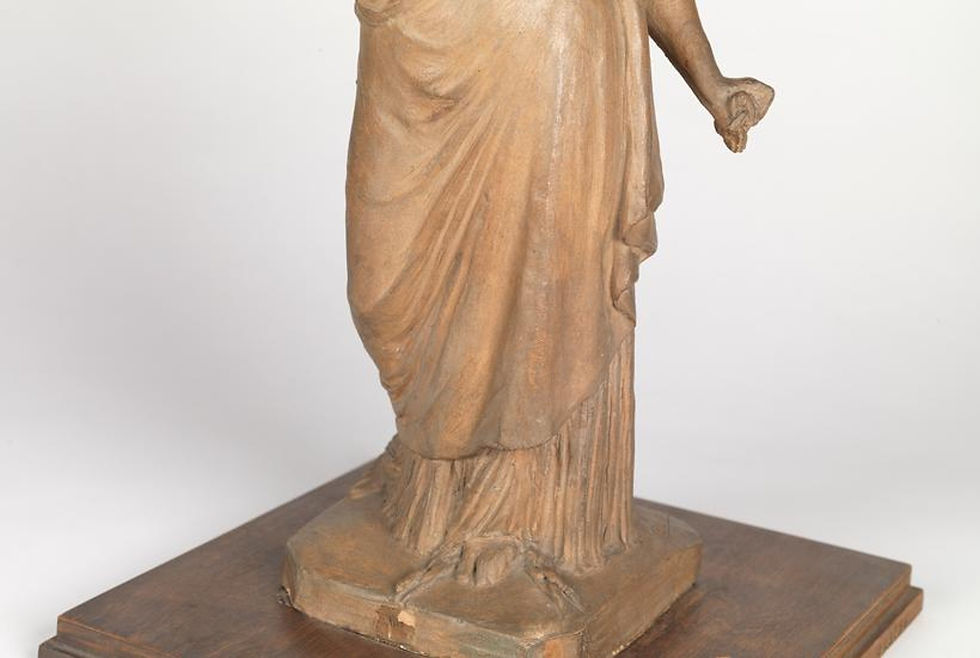
However, as the project progressed, these symbols were repositioned to lie at her feet, partially obscured by her robes. The relocation of the chains was not an artistic choice, but a reflection of the racial climate of the time. This placement rendered the chains less visible to observers, shifting the statue’s emphasis from the abolition of slavery to a generalized representation of liberty.
Post civil war America grappled with reconstruction and the integration of formerly enslaved individuals into society. The decision to downplay the anti-slavery symbolism in the statue’s design can be seen as an attempt to create a national symbol palatable to a populace still deeply divided on issues of race and equality.
By replacing the chains in Liberty’s hand with a tablet inscribed with the date of the Declaration of Independence, the statue’s message broadened to encompass the ideals of freedom and democracy rather than focusing explicitly on emancipation. Over time, the narrative surrounding the monument shifted, and its association with the abolition of slavery diminished.
The statue came to be celebrated primarily as a symbol of welcome to immigrants arriving by sea, embodying the United States as a land of opportunity and refuge. This symbolism reflects a broader tendency to overlook or minimize the experiences and contributions of African-Americans in the nation’s history.
The obscure chains at Lady Liberty’s feet serve as a poignant metaphor for the marginalization of Black narratives in American memory. The deliberate minimization of the statue’s anti-slavery origins underscores the pervasive racism that sought to suppress the acknowledgement of African-Americans struggle for freedom.
By erasing these symbols from a prominent view, American society could more comfortably embrace a version of liberty that did not fully confront the realities of racial injustice.

In recent years, scholars and activists have worked tirelessly to recontextualize the Statue of Liberty, bringing its original anti-slavery symbolism back into public consciousness. Research has uncovered long overlooked documents and historical records, some of which were stored in the lower levels of the statue itself, hidden from public view for years.
These books and archives explicitly detail how the chains were originally intended to be placed in Lady Liberty’s hand as a direct symbol of the end of slavery in America. However, as racial tensions persisted and opposition grew, this powerful imagery was quietly altered, reducing the chains to a less visible position at her feet.
Today, educational initiatives and museum exhibits are striving to present a more honest and nuanced understanding of the statue’s history, acknowledging both its broad representation of liberty and its deep yet deliberately muted ties to the abolition of slavery.
By restoring this missing chapter of history, we can finally give proper recognition to the generations of enslaved African-Americans for whom true liberty was long denied. Recognizing the chains at liberty’s feet invites us to reflect on the complexities of freedom in America.
It challenges us to confront the selective nature of historical memory and to honor the full spectrum of struggles that have shaped the nation’s ideals. The broken
chains at the feet of the Statue of Liberty are more than just a forgotten detail. They reflect America’s complicated relationship with freedom. They symbolize a promise made but never fully honored. A battle fought but never truly won. The decision to hide those chains beneath her robe rather than place them in her hands speaks volumes about how this nation has historically dealt with its legacy of slavery. Not by confronting it, but by minimizing it. By making it less visible, less uncomfortable, less undeniable.
The Statue of Liberty was born out of the struggle for emancipation. Yet, its story was rewritten to fit a more palatable narrative. It became a beacon for immigrants, while its original message, that of Black liberation, was quietly erased from public consciousness.

Today, it stands as both a symbol of hope and a reminder of America’s unfinished work, the fight for true liberty, the kind that recognizes all people as equal, is far from over.


